Why Is Heritage Important?
“If you only have arts, you don’t have culture; you need at least the arts and heritage before you have culture.”
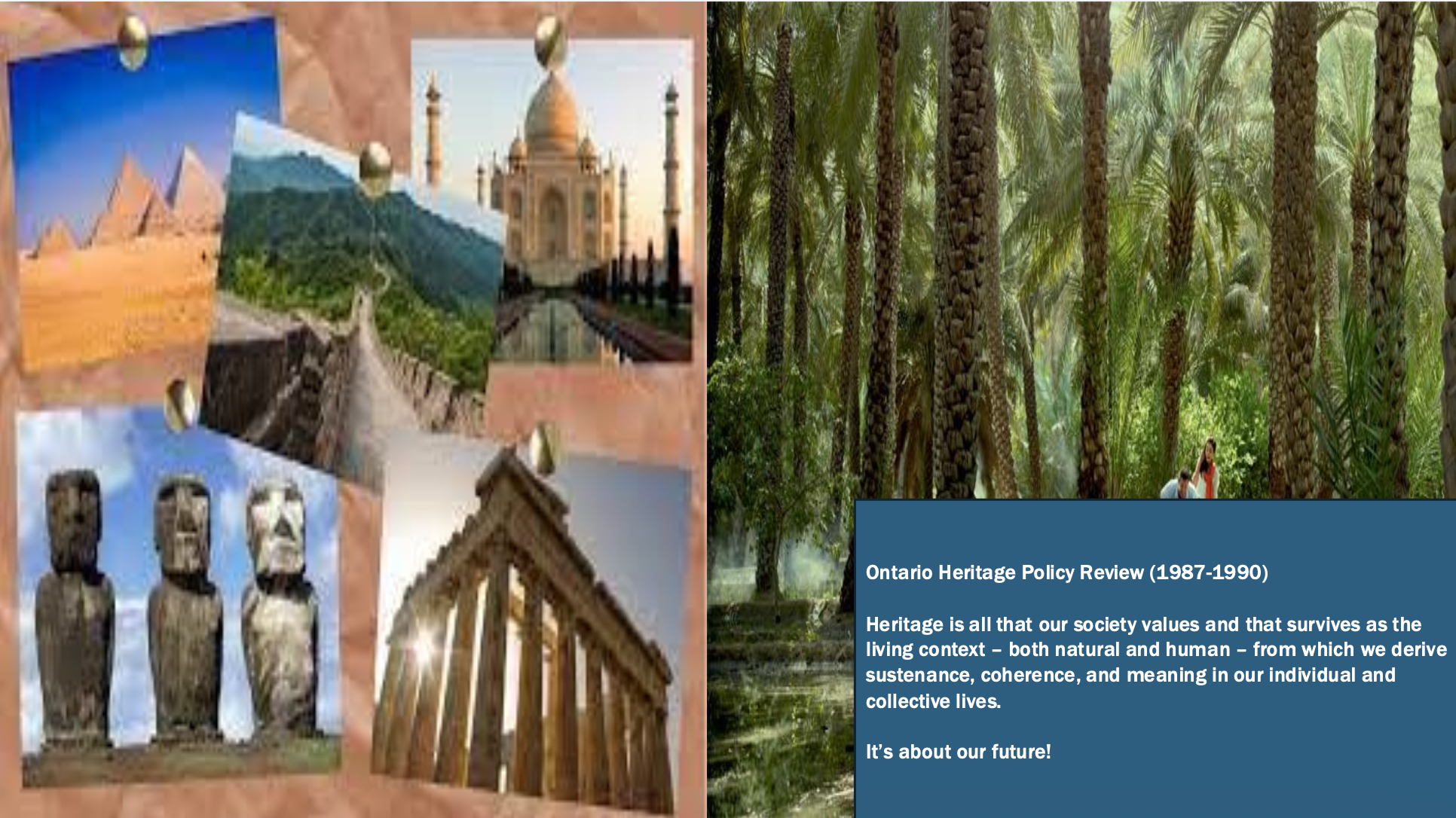
UNESCO defines heritage as the legacy of physical artifacts, cultural legacies, and natural environments passed down through generations. It breaks heritage into distinct categories—Cultural, Natural, Mixed, and Intangible heritage—each governed by international Conventions and Declaration that bind all countries. People on the arts and creative industries side of the sector are surprised to learn that countries are bound by more UNESCO heritage policy commitments than other forms of culture – as important as those are - but attracts half the funding allocated to the arts and creative industries. Heritage funding is $124M, less than arts and creativity - $471M, sports - $300M, and diversity initiatives - $234M. All are important and contribute to cultural vitality and cultural sovereignty at this existential moment in Canadian history but greater equity in funding is needed at all levels of government and the private and voluntary sectors.
The arts are essential to the vitality of cities, but people don’t travel for the arts. Think of the great cities of the world; people travel to experience the unique histories and authentic urban environment – they travel for heritage. People do not visit Jerusalem for its lively local arts scene – or Paris, Rome, Venice, Cairo, Beijing or anywhere for that matter.
On a deeper level E. M. Forster, the English novelist famously wrote “if we cannot remember we cannot understand”. The American architect Robert Stern famously said, “to look far ahead, look far behind”. French anthropologist Claude Lévi-Strauss argued we shouldn’t ‘fetishize’ creativity because true creativity emerges out of something already known (knowledge, context, wisdom) even if it is in opposition to that which is known.
Greg’s work on heritage mobilization can be explored further in the following three slide decks:
UNESCO: Core Heritage Concepts and Principles