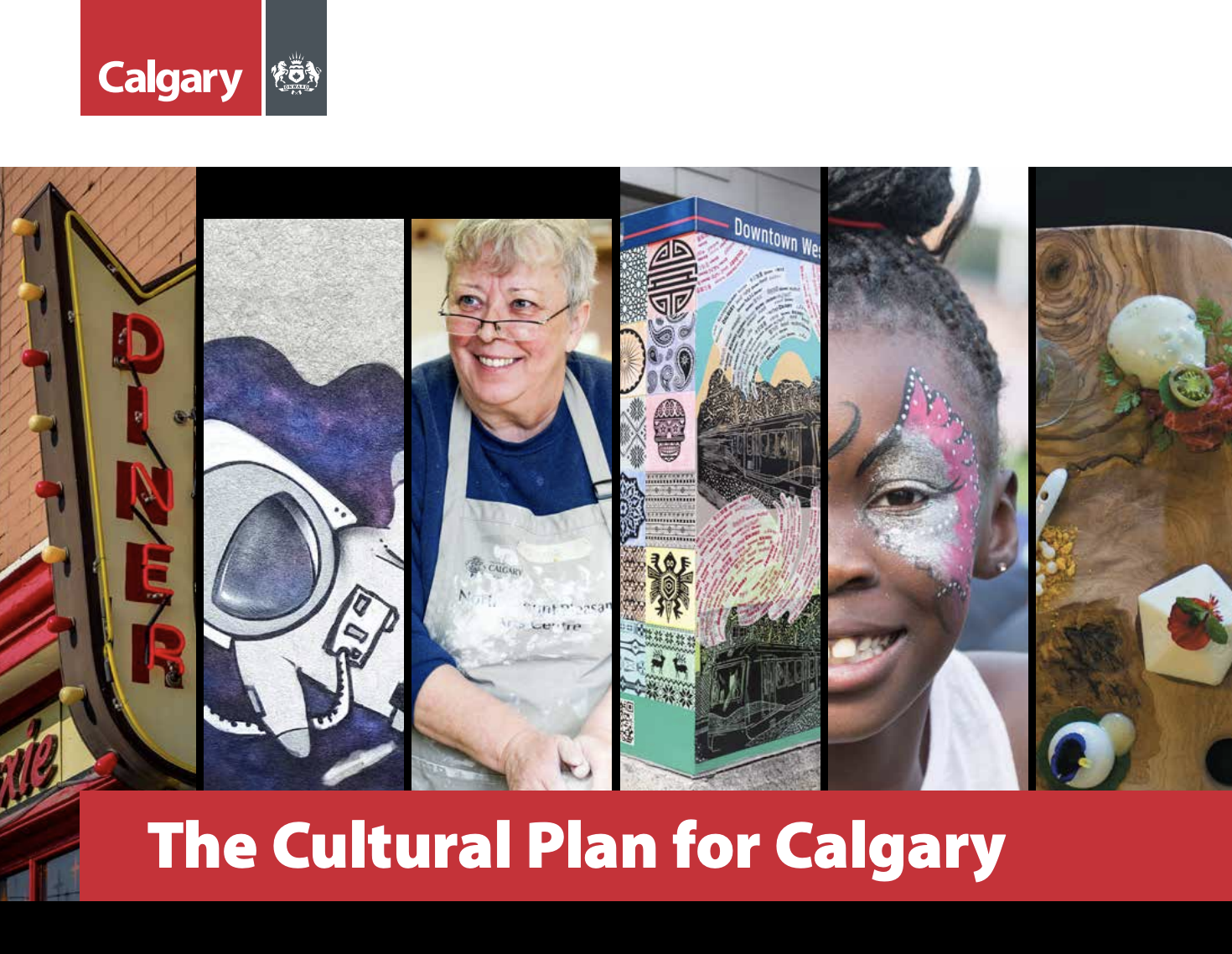
Cultural Plan for Calgary (2016)

In 2016, Calgary was ranked among the most livable cities in the world, with cultural vitality recognized as a defining feature of its success. Building on this foundation, the city advanced an ambitious cultural plan that positioned culture not only as a reflection of civic identity but as a driver of social cohesion, economic diversification, and urban development.

The plan called on The City of Calgary and its partners to address five strategic priorities: strengthening connections across the city’s diverse populations and communities; supporting neighbourhood-level cultural activity; preserving heritage assets; diversifying the economy through investment in cultural industries; and developing Centre City as a distinctive cultural district accessible to all. At the time, it represented the largest investment ever made in a municipal cultural plan in Canada, underscoring the city’s commitment to embedding culture at the heart of its long-term growth strategy.

Public engagement was central to the plan’s development. More than 800 Calgarians contributed input, supported by 600 telephone surveys, a series of community soundings, and an interactive web platform. The process was guided by a steering committee that brought together representatives from City Council, the Mayor’s Office, key community stakeholders, and municipal administration, ensuring alignment across political, civic, and cultural leadership.

At the core of the plan was an extensive cultural mapping initiative, which identified and spatially mapped more than 4,000 cultural assets across the city. These included over 1,200 cultural and creative industries spanning music, film, performing arts, libraries, and museums; 300 community cultural organizations such as ethno-cultural groups and historical societies; 600 cultural facilities and spaces, including places of worship, community halls, and cultural centres; 1,400 cultural and natural heritage resources, from heritage properties and public art to parks and cultural landscapes; and 180 festivals and events. This comprehensive inventory provided the evidentiary base for a new model of cultural planning grounded in place, participation, and resource integration.

Beyond tangible assets, the plan also mapped Calgary’s intangible cultural resources—its stories, histories, customs, and traditions—recognizing these as critical to fostering belonging and identity. Through this work, three “meta-stories” emerged that captured the evolving cultural identity of the city: Calgary as a centre of Western culture, Calgary as a pluralist metropolis, and Calgary as an emerging technology hub. Together, these narratives offered a framework for understanding how the city’s past, present, and future intersect through culture.

A defining feature of the plan was its institutional impact. It established a formal protocol requiring that all recommendations brought forward to Council be assessed for their implications on the cultural life of the city, effectively embedding a “cultural lens” within municipal decision-making. This approach was reinforced by the plan’s central objective: the integration of culture and cultural resources across all municipal plans and strategies. In doing so, Calgary committed to “planning culturally”—ensuring that culture is not treated as a standalone sector, but as a cross-cutting dimension of urban policy, governance, and community development.

The project was delivered by a multidisciplinary team including S. Iley, K. Ball, J. Lavoie, and A. Berry, whose work helped establish Calgary as a leading example of how cities can leverage cultural planning to shape resilient, inclusive, and future-oriented urban environments.

The full report can be viewed here.